
Pulse24 Original
Why Gold Isn't Rallying Despite a Geopolitical Crisis
Gold has matched the S&P 500 over the past decade. Yet the very geopolitical crisis that should be pushing it higher is doing the opposite. Understanding that paradox explains far more than just the gold price.
July 14, 2026
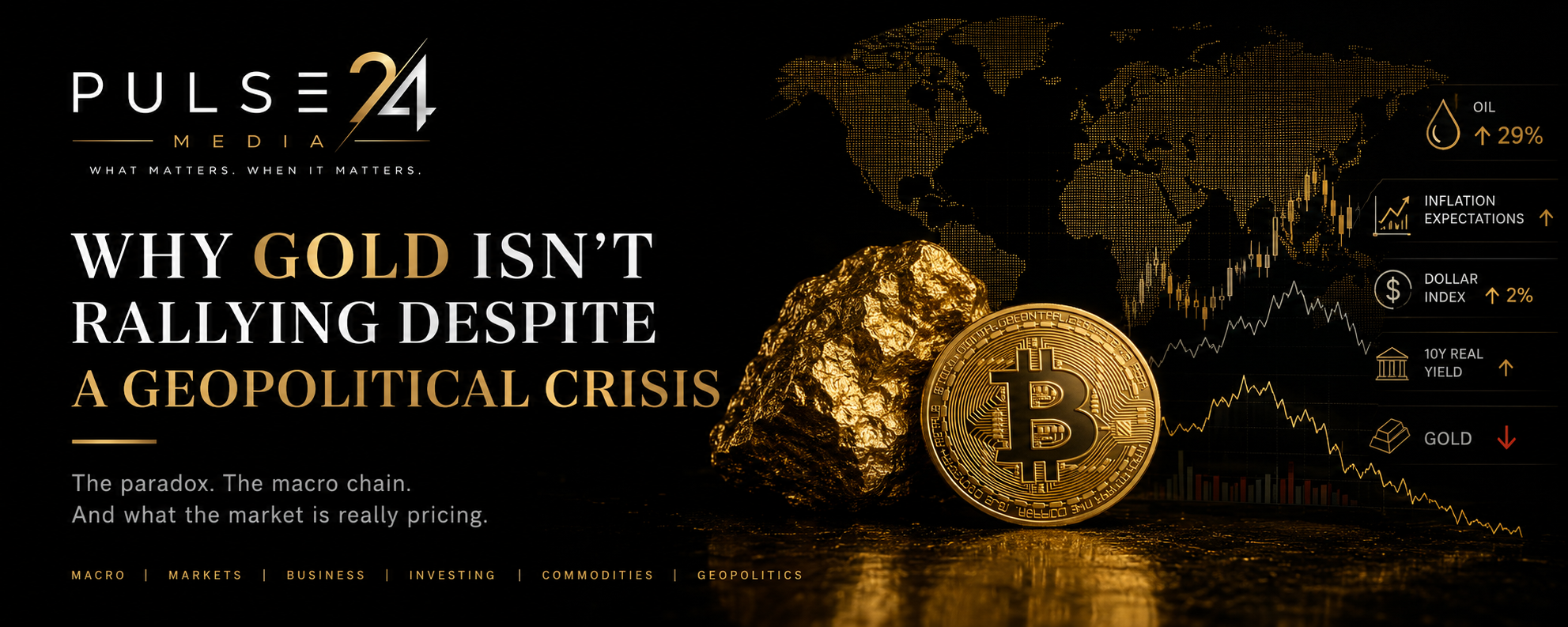
Gold has matched the S&P 500 over the past decade. Yet the very geopolitical crisis that should be pushing it higher is doing the opposite. That's the paradox, and understanding it explains far more than simply watching the gold price.
An asset with no earnings, no buybacks, and no dividend has essentially delivered the same long-term return as the world's largest equity index. A $10,000 investment in gold in 2016 would be worth roughly $40,000 today. The same $10,000 invested in the S&P 500, with dividends reinvested, ends up in almost the same place. After a decade, the difference is remarkably small.
As recently as 2024, this wasn't even close. For most of the past decade, equities comfortably outperformed. Then 2025 happened. Gold surged roughly 65% for the year, while the S&P 500 returned around 18%. One extraordinary year erased what had looked like a permanent performance gap.
Now look at today's market. Oil has surged. Geopolitical tensions have escalated. Normally, those are exactly the conditions that send investors rushing into gold. Instead, gold has struggled to build on its highs.
Why? Because the market isn't pricing geopolitics alone. It's also pricing inflation, interest rates, and the US dollar.
The macro chain
Oil rises. Inflation expectations increase. Treasury yields move higher. The US dollar strengthens. Gold comes under pressure.
That's what makes this cycle different. The same geopolitical event that creates demand for safe havens is also pushing oil higher. Higher oil fuels inflation concerns. Inflation keeps the Federal Reserve more cautious. Higher-for-longer expectations support Treasury yields and the US dollar. And those two forces have become gold's biggest headwind.
That's the paradox. Gold can simultaneously be the world's preferred hedge against geopolitical uncertainty, and still struggle, because the market becomes even more focused on real yields and the dollar. Both forces are true at the same time.
The last decade has already demonstrated something many investors underestimate. Gold doesn't need earnings growth to generate equity-like long-term returns. Its role has never been to replace equities. Its role has been to preserve purchasing power through changing macro regimes. The last ten years made that case remarkably well.
The current pullback doesn't invalidate that correlation. It simply reminds us that gold doesn't trade in isolation. It trades inside a much larger macro system where currencies, inflation, interest rates, and energy prices constantly interact. Sometimes those forces reinforce each other. Sometimes they cancel each other out. Right now, that's exactly what we're witnessing.
The next few weeks aren't really testing gold. They're testing which force the market decides matters more: fear, or the dollar.
How we read the data
Curious how we get from raw data to a take like this? Our Trader's Toolkit walks through the tools we lean on.
Explore the Toolkit